Uganda’s coffee industry spans a wide altitudinal and climatic range, producing both bold robusta and high-altitude Arabica beans. In global trade Uganda has become a powerhouse: it is Africa’s top Robusta exporter and now a significant producer of premium Arabicas. Coffee brings in roughly 20–30% of Uganda’s foreign exchange and supports about 1.7 to 1.8 million rural households. In 2024/25 Uganda harvested on the order of 6.7 million 60-kg bags (~400,000 metric tons) of green coffee, of which roughly 85% is Robusta and 15% Arabica. This “dual-crop” profile is unique in Africa: Uganda’s indigenous Robusta delivers high-volume consistency, while its emerging Arabica (grown in cool mountain microclimates) opens doors to specialty markets.
Diverse Origins and Production Landscape
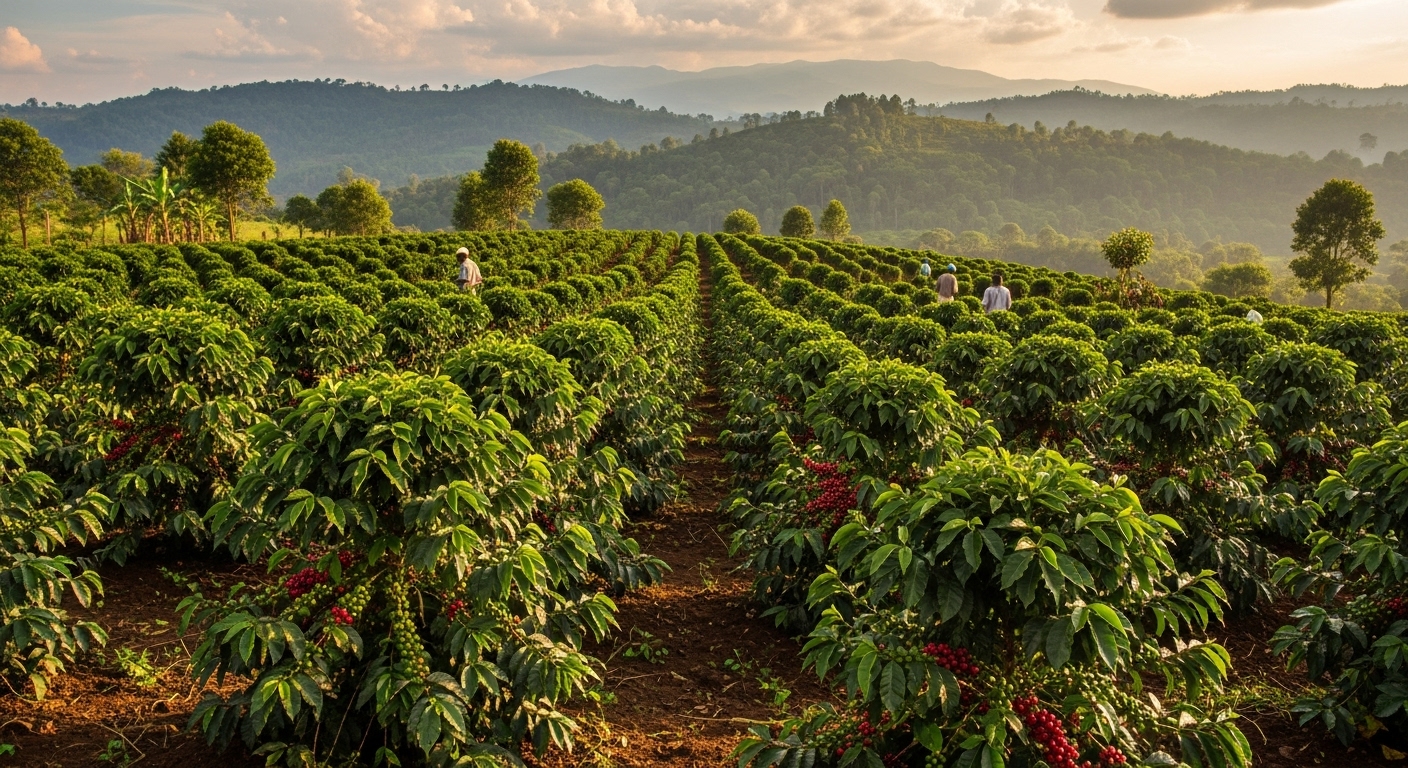
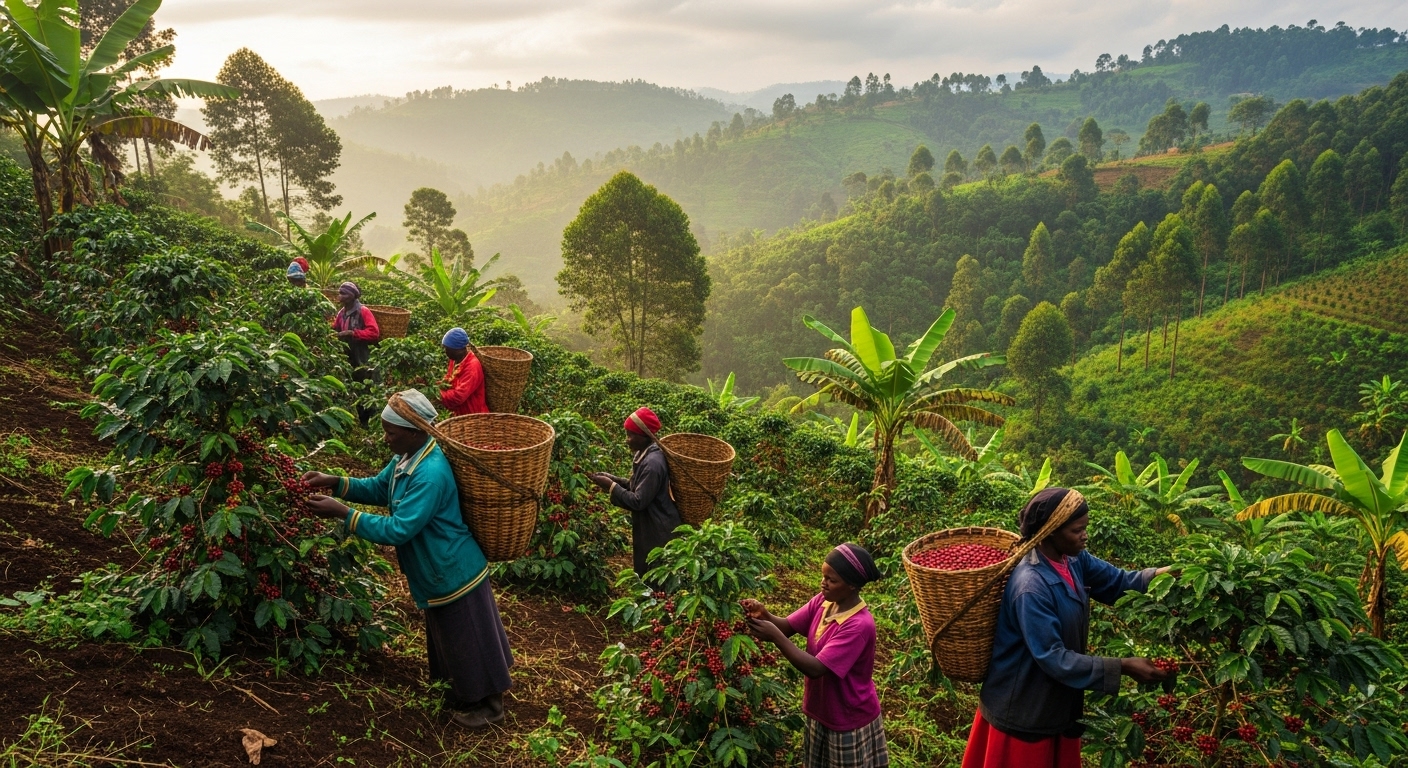
Coffee is grown from lowland basins up to 2,200 m in Uganda, yielding two distinct origin profiles. In the Eastern and Western Highlands (Bugisu/Mount Elgon, Rwenzori, West Nile) the cool, volcanic soils (1,400–2,200 m) favor Arabica. Typical main harvests run from October to March in the east and September–November in the west. The Central and Southern Lowlands (around Lake Victoria, Mukono, Luwero) are warmer and wetter, where robusta thrives with a large mid-year crop. Nearly all coffee in Uganda comes from smallholder farms (0.5–2.5 ha) – over 85–90% of production is by smallholders who often interplant coffee with bananas, beans and shade trees to enrich the soil. A few medium and large estates (mainly in central Uganda) account for the remaining output.
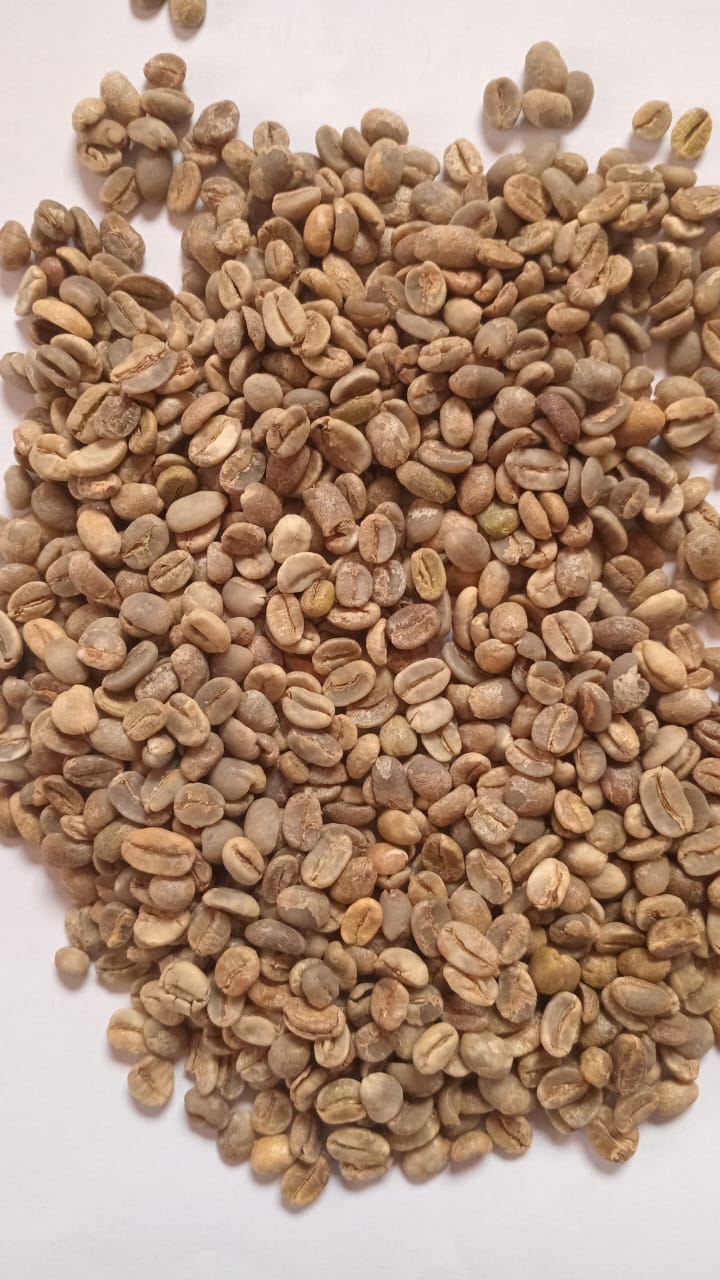
Highland Arabica – Grown on Mount Elgon, the Rwenzoris, and West Nile highlands at ~1,400–2,200 m. These lots (often sold as Bugisu or Rwenzori Arabica) have bright acidity and fruit-forward profiles. Producers harvest a main crop (Oct–Mar) and a smaller “fly” crop in the drier season.
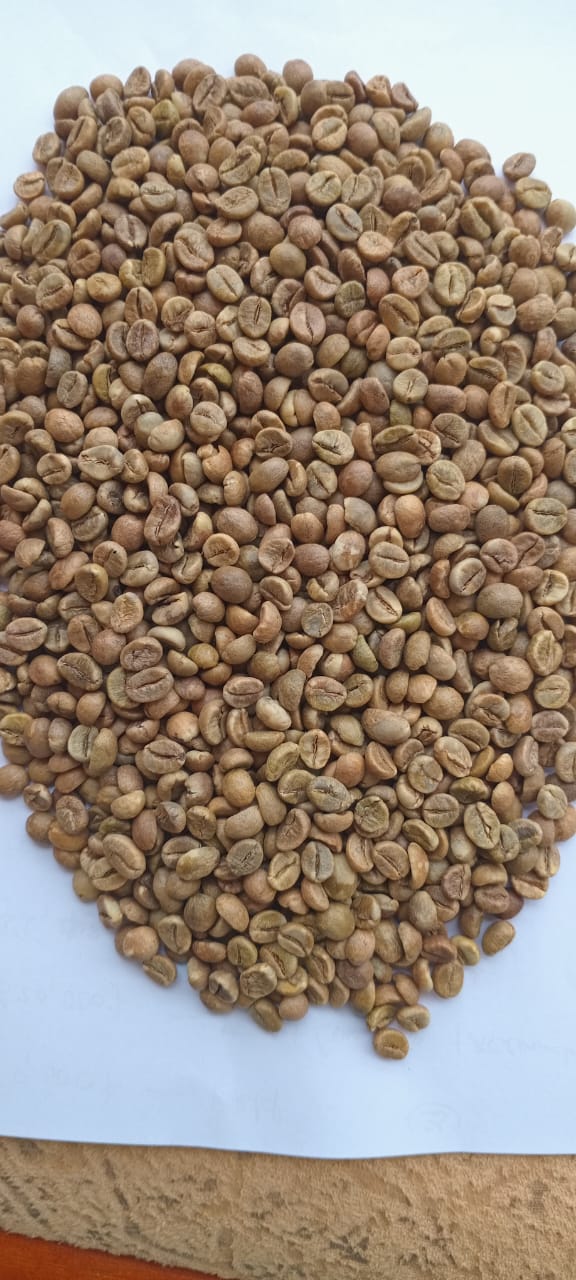
Lowland Robusta – Cultivated below ~1,400 m in central, south-western and Lake Victoria basins. Robusta yields are very high and drought-tolerant. Harvest peaks in September–November (with a fly crop in April–July in some zones). Robusta beans have full body and high caffeine, suited to blends and instant coffee.
Smallholder focus – Coffee is primarily grown by about 1.8 million smallholder families. Farm sizes average under 0.5 ha, and farmers rely on cooperatives and local collection centers. Intercropping with bananas, beans or legumes for shade is common to maintain soil fertility (banana–coffee is a typical intercrop). This decentralized structure ensures traceability and farmer engagement in quality, but also means product aggregation through hundreds of trader cooperatives and over 900 licensed “hulling/processing” stations nationwide.
Processing Methods and Flavor Profiles
Ugandan coffees are processed and cupped in diverse ways:
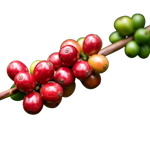
Cup profiles: Arabica beans (e.g. Bugisu AA, Nile Gold) are prized for their bright acidity and complex flavor notes. Tasters often note citrus, berry or stone-fruit aromas and a “winey” finish. Robusta beans (e.g. Central Uganda RFA grades) yield a heavy, earthy cup with chocolate, nutty and smoky notes; they produce a thick crema and high body. Newer high-altitude Robusta lots are also gaining recognition for subtle sweetness.
Processing methods: Both washed (wet-milled) and natural (dry) processing are used. Washed coffees – especially Arabicas from Mt. Elgon – show clean, bright acidity and floral-fruity notes. Natural (sun-dried, “drugar”) coffees – particularly from Rwenzori – are darker and jammy, with berry flavors and a rich mouthfeel. Honey or pulped-natural processing (common in Bugisu) is rising: by leaving some mucilage on the beans, it balances sweetness and acidity and yields coffee that is both clean and full-bodied.
Grading and certifications: Uganda enforces strict screen-sizing and defect standards on export coffee. Many cooperatives pursue voluntary certifications: by 2020 Ankole Coffee (ACPCU) was exporting 200+ containers of organic Fairtrade Robusta from 10,000 farmers. Rainforest Alliance, UTZ and Organic certifications are common, assuring importers of consistent quality and social/environmental compliance.
Competitive Edge and National Support
Uganda’s coffee sector enjoys several competitive advantages and strong public-private support:
Favorable climate and soils: Uganda’s location on the equator ensures year-round coffee growth. High rainfall (especially in SW and East) and fertile volcanic soils (in Elgon and Rwenzori regions) create ideal conditions for coffee cultivation. Ugandan robusta, native to local forests, is well-adapted to heat and humidity, while the highland microclimates yield bright Arabicas. Diverse ecosystems (forest and farmland) allow multiple harvests and resilience against climate variability.
Government initiatives: Coffee is a strategic export crop under Uganda’s National Development Plan (NDP III). The Uganda Coffee Development Authority (UCDA) drives an aggressive “Coffee Roadmap” targeting quality and volume gains. Current goals include roughly tripling output to ~20 million bags by 2030. Key programs have been launched: for example, the 2013 Operation Wealth Creation program (in partnership with UCDA) distributed millions of new seedlings nationwide (with local leaders and faith groups mobilizing farmers). The Ministry of Agriculture now provides low-interest loans and field agronomists to farmers. Exporters and cooperatives receive training in cupping, post-harvest hygiene and EUDR compliance to boost quality. As a result, Uganda’s specialty arabica (e.g. Bugisu AA, Mt. Elgon lots) has repeatedly earned top cup scores.
Traceability, cooperatives and sustainability: Uganda has built strong cooperative unions (e.g. ACPCU, Bukonzo, Ankole) that aggregate smallholders into export chains. These co-ops have experience with international certifications and digital traceability. For instance, cooperatives are adopting blockchain tools to meet EU traceability regulations. The government emphasizes verifiable sourcing and quality control – an approach that has “won confidence in Europe, the Middle East and now Asia”. In practice, this means farms are geo-tagged, and quality checks (moisture, size, cupping) are performed pre-export. Sustainability is also a focus: many farms use organic fertilizers and shade trees for wildlife. The combined emphasis on farmer support, co-op networks and sustainable practices ensures that Uganda can scale volume without sacrificing quality or ethics.
Export Readiness and Infrastructure
Uganda is landlocked, but it has well-developed export logistics and market access frameworks:
Transport corridors: Coffee travels to port via the Northern Corridor (Kampala → Mombasa, Kenya) or Central Corridor (via Dar es Salaam, Tanzania). The Northern route is fastest: for example, a 20-foot container from Kampala to Mombasa costs about US$1,200 (≈US$0.09/kg of coffee). New road and rail upgrades (including the standard-gauge railway to Mombasa) are reducing transit times. Uganda’s exporters typically use FCA (Free Carrier) contracts, transferring the cargo at Kampala. Improved road linkages (like the Kampala–Malaba highway) and reduced border delays continue to improve access to seaports.
Export network: Over 100 licensed exporters and 34 export grading plants operate in Uganda. Around 900 coffee hulling stations and hundreds of buying centers collect beans from farms. Warehouses in Kampala and regional towns allow year-round sales. UCDA publishes daily and monthly market reports so traders can time shipments. (As a result, Uganda has built one of Africa’s most responsive coffee trading systems, with farmers selling beans within days of harvest.)
Trade agreements: As a Least Developed Country, Uganda enjoys duty-free, quota-free access to major markets. Under the EU’s Everything-But-Arms (EBA) scheme, virtually all Ugandan coffee (even roasted) enters Europe duty-free. In the United States, Uganda is AGOA-eligible, meaning its coffee exports also face no tariffs under the African Growth & Opportunity Act. Regionally, Uganda is a member of COMESA and the East African Community; intra-COMESA trade is generally duty-free. (These agreements simplify documentation and lower export costs for importers buying Ugandan beans.)
Global Market Potential by Region
Europe – Specialty and Certifications: Europe remains Uganda’s largest market (about 64–67% of exports). Buyers in Italy, Germany, the UK and Scandinavia favor origin coffees with clear profiles. The specialty segment is growing – for example, UK demand for East African Arabicas is “buzzing”. European roasters pay premiums for certified, traceable beans, so Ugandan coffees with Fairtrade/Rainforest/organic seals (from Bukonzo, Ankole, etc.) are well-positioned. Notably, Italy alone imported about 39% of Uganda’s coffee volume, reflecting Europe’s appetite for blends and single-origin robustas.
Asia – Rapid Growth: Asian markets (currently ~19% of Uganda’s exports) are expanding. Japan, China and South Korea are building café cultures and demand both soluble and specialty coffee. Uganda has recently promoted its premium lots in Asia (e.g. the SCAJ Tokyo expo highlighted Mt. Elgon AA and Rwenzori naturals). On the commodity side, Asian food & beverage manufacturers need robusta for instant and espresso blends (Vietnam’s 30M-bag output is an example). Ugandan robusta – known for its consistency and high caffeine – can meet this demand. Meanwhile, Asia’s specialty importers (e.g. Japan, South Korea) are open to new beans that command high quality, and Uganda’s Arabicas can penetrate those niches.
Middle East – Premium Retail: The Middle East (Gulf countries, Levant) is a high-value market for coffee, driven by upscale cafés and specialty chains. Consumers in the UAE, Saudi Arabia, Qatar etc. increasingly seek premium Arabicas and unique blends. Uganda’s narrative of sustainable, halal-friendly coffee (shade-grown, deforestation-free) resonates well here. Though current volumes are modest, retailers are beginning to stock Ugandan high-grade arabica (e.g. bugisu arabicas) alongside Ethiopian. Notably, Uganda’s emphasis on traceability and certifications has “won confidence in the Middle East”, making it a credible origin for discerning buyers.
North America – Traceable Specialty: The U.S. and Canada still import a small share of Uganda’s volume (~4%, but the North American specialty market values what Uganda offers. Buyers here pay 15–25% premiums for fully traceable, ethically-sourced coffee. Ugandan cooperatives (e.g. ACPCU, Bukonzo) are already Fairtrade/organic certified, and they are adopting digital traceability to meet new standards. As a result, importers can highlight both scale and social impact: Uganda can supply robustas for branded instant or bulk blends, while also providing traceable micros-lots for roasters. In short, North American buyers in search of “coffee with a story” will find Uganda’s dual-crop advantage and cooperative model compelling.
In summary, Uganda offers importers the rare combination of scale and quality. Its dual-crop system means one origin can feed commodity markets (through high-volume Robusta) and specialty markets (with exceptional highland Arabicas). Strategic support from UCDA and the government, from seedling programs to quality certification, has rapidly elevated Uganda’s coffee reputation. With robust infrastructure links (ports, roads, export warehouses) and duty-free market access (EU, US, regional), Uganda is an increasingly reliable supplier for global roasters and food processors. In effect, Uganda’s “Pearl of Africa” moniker now applies to both volume and varietal diversity: importers seeking a competitive edge can source both bulk and boutique coffee from a single, sustainable origin.
MO AND TIBA UGANDA LIMITED exports premium Ugandan Arabica and Robusta coffee to importers and food manufacturers around the world. Carefully cultivated, hand-selected and rigorously inspected, our beans deliver a bright acidity and complex flavor notes, citrus, berry or stone-fruit aromas, consistent bean quality and a dependable year-round supply, the perfect ingredient for brands that insist on authenticity and traceability.